Arizona Envirothon 2015
Urban/Community ForestryScientific Articles
Scientific articles can be excellent sources of actual data and broad concepts about an environmental issue. Scientific articles are usually peer reviewed by independent experts. Peer review doesn't necessarily guarantee that articles are free of errors, but it does lend substantial credibility to an article. Scientific articles range in scope from general reviews of an issue to specific research studies about a very small part of an issue. The links below cover that full range.
Note for teachers and coaches: These articles are not terribly tough academically relative to typical science articles, but some do contain sections of statistics, etc., that could be difficult for high schoolers. It might be best for you to read these articles first and highlight the need-to-know stuff while blocking out gory details of methods and quantitative analyses.
The articles:
- Arizona's Forest Resources, 1999: This is a must-read for Arizona Envirothon. This Forest Service publication documents important statistics about trees and forests of Arizona. At first glance, this is a huge document, but don't despair—you need read only pages 1-19; the rest is glossary and appendix stuff. I recommend focusing on the following figures and their meanings:
- Fig. 3: A state-wide forest vegetation map. Match this with a topo map of the state and make your own associations.
- Fig. 6: On the basis of acreage, what forest type dominates in Arizona, by far?
- Figs. 13 & 14: On the basis of total wood biomass, what forest type dominates in Arizona, by far?
- Fig. 21: Are Arizona's forests currently dieing out or growing more wood than ever?
- Ecosystem Goods and Services (general): Have you ever wondered, Why conserve natural ecosystems? What good is a forest, or a desert, or a wetland? In other words, why bother studying forestry in Envirothon? This publication, from the Ecological Society of America, our country's leading authority on things ecological, documents the benefits that we humans derive from healthy, intact ecosystems. It also estimates a dollar value on those goods and services, allowing the justification of practically any argument to conserve natural ecosystems. This is a must-read for Arizona Envirothon!
- Ecosystem services in urban areas: This article identifies specific benefits and services of urban ecosystems, including urban forests. A good source of specific talking points for Envirothon.
Benefits and Costs of Urban Forestry
- Municipal Forest Benefits and Costs in Five US Cities: This article documents economic pluses and minuses of urban trees in five US cities, including Glendale, Arizona.
Carbon and Urban Forestry
It's commonly stated that trees should be planted to sequester (suck up and store) atmospheric CO2. Fine: trees do inhale CO2, and wood is upwards of 40 to 50% carbon. However, just how effective are urban forests at making a dent in the issue of increasing atmospheric CO2?
Some basic plant ecology: Can you explain the grand carbon equation of life?
- Green plants (ag crops, trees, cactus, you name it) take this equation in both directions, right and left. In which direction would it be called photosynthesis? Respiration?
- Do you participate in this equation? If so, when? Which direction?
- By the way, be careful with the big numbers for carbon (C) versus carbon dioxide (CO2). CO2 (mw = 44) is 3.67x heavier than C (aw = 12).
Carbon storage and sequestration by trees in urban and community areas of the United States: Numbers on just how important urban forests are for sequestering atmospheric CO2. Surprising.
Quantifying the Role of Urban Forests in Removing Atmospheric Carbon Dioxide: More numbers how much can be by individuals (you) to sequester atmospheric CO2. Surprising.
Click here for up-to-date numbers on CO2 emissions in the US.
Click here for up-to-date numbers on CO2 emissions globally.
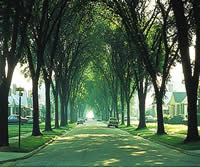
The American Elm Story American elm was arguably the finest urban tree species of all in the US. Planted extensively, it graced Main St. America nearly everywhere. Then, in the early 1930s, a fungus from Europe was introduced onto this continent, and, transported by beetles, it decimated the entire species. Known as Dutch elm disease, it completely altered urban forests. Academic discussion of urban forestry is not complete without knowing the American elm story.
US Forest Service photo
- The American Elm: This 1930s publication details what was happening early in the Dutch Elm crisis. Nice pictures and poetic text. No need to read all of this, but enjoy relevant sections. Also, translate this experience to what you know of urban forestry today in Arizona. Can this "national catastrophe" (page 29) be avoided nowadays?
- American Elm Restoration: An example of modern efforts to restore American elm. Any application of this strategy to urban forestry in Arizona?
AZ Envirothon Forestry Links Home
Scientific Articles Newspaper Articles Other Web Links
Arizona Envirothon National Conservation Foundation Envirothon
Laboratory of Tree-Ring Research, University of Arizona
Tucson, Arizona 85721 USA
Main Office: (520) 621-1608, Fax: (520) 621-8229
Comments to Paul Sheppard: sheppard @ ltrr.arizona.edu
Copyright © 2002-2015 Laboratory of Tree-Ring Research, University of Arizona
Revised — January, 2015